
One of the largest aircraft used during World War Two, Boeing's B-29 Superfortress was also one of the most advanced piston-engined craft of the era. In a time when pilots still had to rely on oxygen masks at altitude, and defensive gunners often stood at open windows, the B-29 had a pressurized cabin and an advanced remotely controlled armament system. The B-29 could also cruise at very high altitudes and speeds, with maximums of 40,000 feet and 350 mph, respectively. It was truly a remarkable airplane for the late 40's.
Despite teething troubles-particularly with the new Wright R-3350 engines-the B-29 managed to become a successful bomber, and was instrumental in the air war in the Pacific. It also continued in service through the 1950's, the final airframes being retired in the early 60's. The B-29 proved to be a fairly versatile airplane, being used as a testbed for new technologies, weather tracking, and possibly most famously as the mother ship for the Bell X-1 project, which culminated in Chuck Yeager's supersonic flight.
This is Fifi, which is flown at airshows by the Commemorative Air Force. Of the 3,970 B-29's built between 1943 and 1946, just twenty-six survive, and Fifi is the only one that's airworthy.
Showing posts with label aviation history. Show all posts
Showing posts with label aviation history. Show all posts
Tuesday, July 26, 2011
Fifi


Tuesday, July 19, 2011
Texan

Rugged, relatively fast, and forgiving, North American's AT-6 Texan (or SNJ if you're in the Navy, or the Harvard if you're with the RAF) was an excellent advanced training craft. It was also a long serving one, with Harvards remaining in use with the South African air force until the mid 90's, as well as an example, brought on strength with the RAF in 1945, still being used as a helicopter chase plane as late as 1995. That's a pretty good run for an airframe designed in the mid 1930's!
The Texan was also built in fairly large numbers, and since it wasn't a combat plane they tended to remain fairly safe. Consequently a lot of them have survived, and they remain popular airshow attractions. This one made a perfect TtV subject.
Wednesday, June 29, 2011
The Liberty Belle
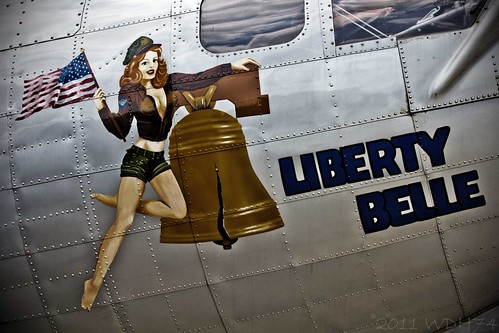
I recounted a bit about Boeing's B-17 a week or so ago, but felt it was worthwhile to show you another, clearer photo of the Liberty Belle's nose art. The practice of personalizing aircraft began during before World War One, particularly with German and Italian pilots. During the war German pilots were renowned for painting all manner of garish designs on their mounts, with scant regard to camouflage-after all, the Red Baron was a real pilot, and his personal planes were all pure scarlet. Other popular motifs were mouths painted around the propeller spinners, as well as the American tradition of squadron logos on the sides of planes.
But, nose art truly came into it's own during the second World War. Often considered the Golden Age of this particular art, both Axis and Allied pilots indulged, particularly American bomber crews. In fact, when one thinks of nose art one almost automatically imagines a big B-24 or something, with a cartoon character or Vargas girl splashed on the side. Good artists were in high demand within Air Corps squadrons, and were well paid by the crews for their services. Popular themes were cartoon characters, tributes to famous people, and the aforementioned Vargas-style pinups.
The Liberty Belle is a good example of the latter. Sadly, she's no more, having crashed soon after takeoff on June 13, 2011.
Tuesday, June 21, 2011
Through The Viewfinder Tuesday
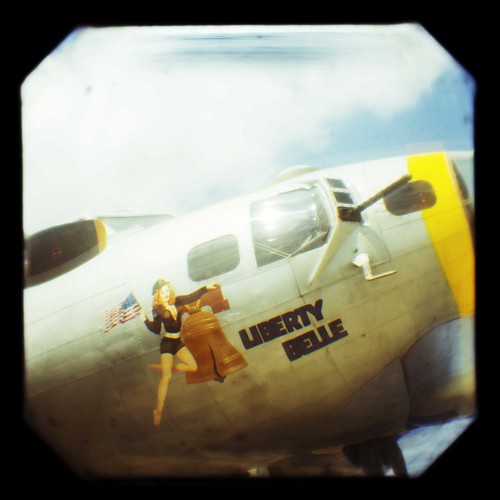
As I promised last week, a Boeing B-17 Flying Fortress. One of the most famous aircraft of the Second World War, the B-17 was the backbone of the USAAF's bomber forces in Europe. A tough, reliable airplane, the Fort quickly gained almost mythic status, after photographs of grievously damaged airplanes began to circulate, showing dramatically wounded examples that still managed to get their crews home safely. So right was the B-17's design, the final examples didn't leave service-with the Brazilian Air Force-until 1968, and civilianized examples continued to fly for a few years yet.
Sadly, this particular example no longer exists. Soon after takeoff on June 13, 2011, the Liberty Belle caught fire and made an emergency landing in a field near Aurora, Illinois. None of the passengers onboard was injured, but the Belle burned to the ground.
Thursday, June 16, 2011
Boeing

Founded in 1916, Boeing is probably one of, if not the, best known airplane manufacturer in the world. Initially providing seaplanes for the Navy and then fighters for the Army, Boeing eventually became known for their big, multi-engined craft, including the 247, the first truly modern airliner, and the famous Model 314 Clippers that plied long-distance routes the world over. This continued into World War Two, with Boeing's big bomber planes forming the backbone of the U.S. Army Air Corps. Today, of course, they're best known for their airliners, which are familiar in airports the world over.
This is Boeing's original logo, which was used until after the war. This particular one is on the co-pilot's wheel of a B-17G, about which I'll be writing more in the near future.
Subscribe to:
Posts (Atom)