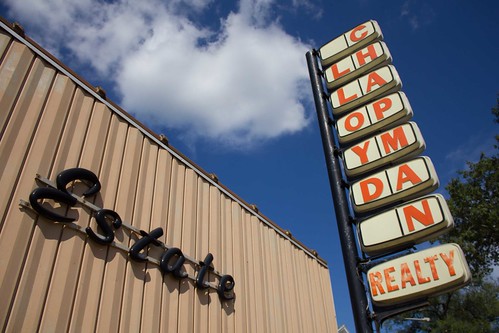
You see a lot of those little rectangular vacuform signs around-they were ubiquitous at one time and a lot of them have remained. Usually you'll see one or two segments on a given sign, but this one has eight-a definite record for me! Anyway, this carbon dated beauty is in Ottawa, Illinois.
Do they even make these signs anymore?
Wednesday, October 17, 2012


Monday, October 15, 2012
Monterey
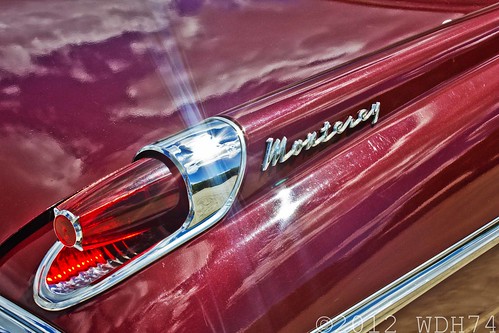
Mercury's Monterey was the company's jack of all trades, at various times being the entry level, mid-level, and top of the line full-sized offering. Introduced in 1950 as an upscale coupe in the Mercury Eight line, the Monterey became it's own model line two years later, with coupe, convertible, and sedans on offer.
This taillight is from a '61 coupe.
This taillight is from a '61 coupe.
Wednesday, October 10, 2012
Trolley
This is the former Chicago Surface Lines #3142, one of 169 steel "pay as you enter" streetcars ordered in the early 20's. Built in 1923 by the J.G. Brill Company, 3142 was used by CSL, and later the CTA, until 1953, when it was parked and used as storage at the CTA's South Shops. Donated to the Illinois Railway Museum in 1973, a fifteen year restoration finally put it back on the tracks. Today it is the only surviving CSL steel "arch roof" streetcar.
I saw this operating at the museum, and got it rolling past the Museum's Riverview billboard. I like to think that 3142 delivered patrons to the park at one time.

I saw this operating at the museum, and got it rolling past the Museum's Riverview billboard. I like to think that 3142 delivered patrons to the park at one time.
Monday, October 8, 2012
Gas Class
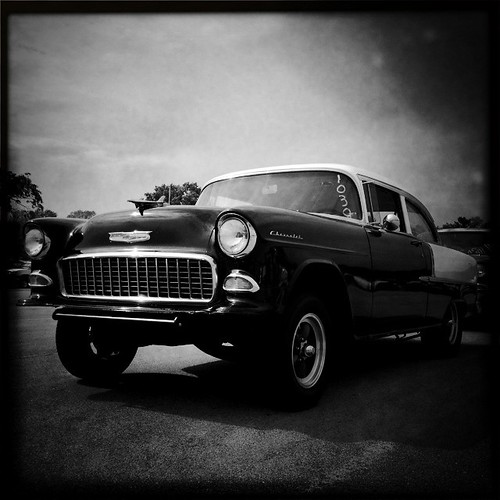
A predecessor to the modern Funny Car, Gassers were popular from the later 50's up until the early 70's.So named because they used regular gasoline instead of exotic fuel cocktails like methanol or nitromethane, gassers were typically based on old, used cars that could be bought cheaply. The cars were usually stripped out, often with fiberglass bodywork, plexiglass windows, drilled straight axles, and that nose high stance for better weight transfer.
The archetypical gasser is probably the late 30's and early 40's Willys Americar (to the point where I've never actually seen a stock Willys), but plenty of other cars got the Gas Class Treatment. Probably second most popular is the Tri-Five Chevy, usually the squarer '55's (although I've seen a couple of iconic '57 gassers as well). This one was pretty mild by Gas Class standards, more of a street/strip car with it's full compliment of steel panels, glass, and chrome. Still, it ran fast down the strip and looked awesome doing it.
The archetypical gasser is probably the late 30's and early 40's Willys Americar (to the point where I've never actually seen a stock Willys), but plenty of other cars got the Gas Class Treatment. Probably second most popular is the Tri-Five Chevy, usually the squarer '55's (although I've seen a couple of iconic '57 gassers as well). This one was pretty mild by Gas Class standards, more of a street/strip car with it's full compliment of steel panels, glass, and chrome. Still, it ran fast down the strip and looked awesome doing it.
Saturday, October 6, 2012
Larson's
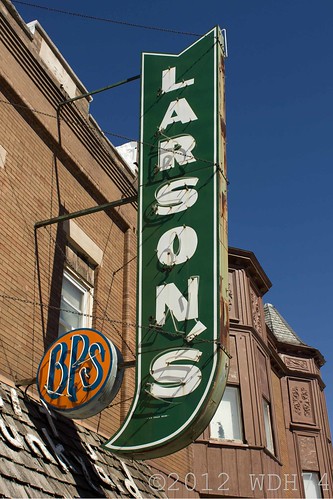
This sign is a bit of a mystery to me. It's in the town of LaSalle, Illinois, tucked away from the downtown area, in a section that looks like it is (or was) a neighborhood shopping district. Just a few storefronts and an old gas station. The current business is an antique/junk type of shop (it didn't look open the day I was there), but it's not called Larson's. So I really have no idea what a Larson's is or was.My best guess is a restaurant or bar, but what's "BPS" mean?
I mean, look at it. This is a really nice sign. The colors are great, and most of the glass is still there, and it's not all rusted through. My research so far has turned up exactly one reference to this building, and that's my photo.
Any ideas?
I mean, look at it. This is a really nice sign. The colors are great, and most of the glass is still there, and it's not all rusted through. My research so far has turned up exactly one reference to this building, and that's my photo.
Any ideas?
Thursday, October 4, 2012
Transit
Faded Waukegan & North Chicago Transit logo, on the side of a derelict ACF bus, which is parked out back behind one of the buildings at the Illinois Railway Museum.
Also, it looks like Rebecca was here.
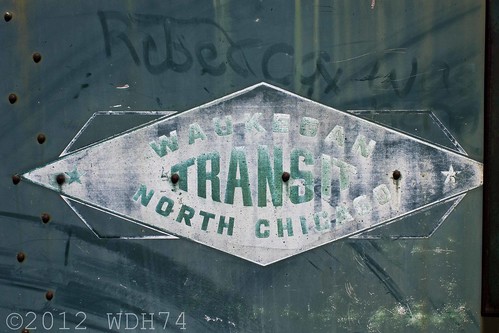
Also, it looks like Rebecca was here.
Monday, October 1, 2012
Hemi
Some engines are known by their numbers-289, 350, 427, 3.8 litre (that's a Jaguar). Some by their name-Flathead, Commando, Twin-Spark (that's an Alfa Romeo). But one seems to always tower above all the rest-Hemi.
In the broadest terms, a "hemi engine" is just an internal combustion engine with hemispherical combustion chambers at the top. This puts the intake and exhaust valves on opposite sides, providing a direct path for the gases to flow across the combustion chamber. It's an old design, dating to the early twentieth century, and plenty of illustrious manufacturers used the design. Alfa Romeo, Peugeot, Ford, BMW, Bristol, and the wonderful racing engines of Harry Miller all used this design. However, when you say the word "Hemi", one other word usually pops into your head-Chrysler (or maybe Dodge. Or Plymouth. Or DeSoto if you're weird).
Chrysler has been the largest, and arguably most famous, proponent of the hemi-head design. Best known in it's mid sixties 426 version, Chrysler's earliest hemis were introduced in 1951, to power the company's big luxury cruisers. Hot rodders and drag racers soon learned that these engines were quite a bit more powerful than the Ford flathead V-8, and they were easy to tune and able to take serious amounts of forced induction. In fact, these early engines were popular well into the sixties, after they ceased production-plenty of top flight drag racers were using them, running huge blowers and nitromethane on junkyard blocks.
This one's a Fire Power that I saw in a hot rod-I was told it came out of a '54 New Yorker.
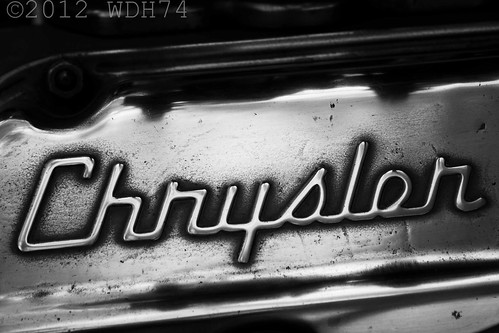
In the broadest terms, a "hemi engine" is just an internal combustion engine with hemispherical combustion chambers at the top. This puts the intake and exhaust valves on opposite sides, providing a direct path for the gases to flow across the combustion chamber. It's an old design, dating to the early twentieth century, and plenty of illustrious manufacturers used the design. Alfa Romeo, Peugeot, Ford, BMW, Bristol, and the wonderful racing engines of Harry Miller all used this design. However, when you say the word "Hemi", one other word usually pops into your head-Chrysler (or maybe Dodge. Or Plymouth. Or DeSoto if you're weird).
Chrysler has been the largest, and arguably most famous, proponent of the hemi-head design. Best known in it's mid sixties 426 version, Chrysler's earliest hemis were introduced in 1951, to power the company's big luxury cruisers. Hot rodders and drag racers soon learned that these engines were quite a bit more powerful than the Ford flathead V-8, and they were easy to tune and able to take serious amounts of forced induction. In fact, these early engines were popular well into the sixties, after they ceased production-plenty of top flight drag racers were using them, running huge blowers and nitromethane on junkyard blocks.
This one's a Fire Power that I saw in a hot rod-I was told it came out of a '54 New Yorker.
Subscribe to:
Posts (Atom)